Grantee Spotlight: Rocky Mountain Biological Laboratory Youth Programs
‘Kids learning to be curious and enjoy exploring’
For nearly a century, scientists have flocked to Rocky Mountain Biological Laboratory (RMBL).
Even before RMBL’s 1928 founding, a Western Colorado University professor brought his students to the townsite to study local ecosystems. Ninety-eight years later, RMBL continues that legacy through its youth programs, comprising summer camps and public-school partnerships.
“It would be a lost opportunity not to bring our local kids into this educational environment to see what field science is like,” said RMBL Science Director Jenny Reithel.
The youth programs are based out of Gothic and surrounding public lands, placing students directly inside one of the most active field research stations in the country. Each summer, roughly 200 to 250 scientists arrive at RMBL to work on some 100 ongoing research projects.
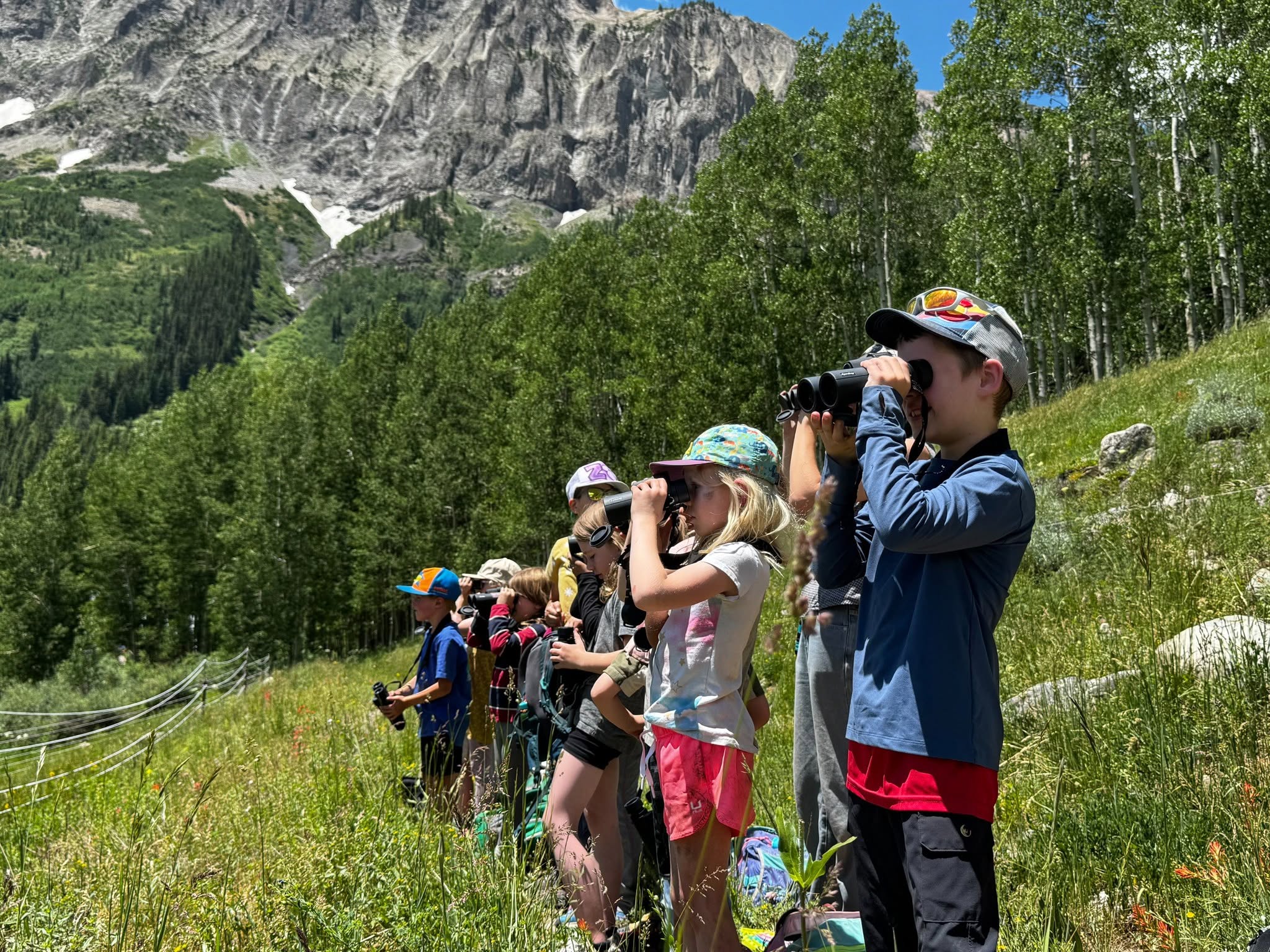
Today, RMBL offers programming for nearly every age group: Nature Camp for kindergarten through second grade, Science Camp for grades three through five, Project Eco-STEM for middle schoolers, and a two-week Introduction to Field Biology course for high schoolers.
Additionally, Gunnison Watershed students visit RMBL’s Gothic campus three times before reaching high school: in third, fifth and seventh grades. RMBL educators make classroom visits throughout the school year as well. Every lesson and activity is tailored to required educational standards, with anchors in local data and landscapes.
“It’s helping the students draw a line between the science that’s theoretical and actual praxis,” Reithel said. “It helps them understand.”
One signature activity involves wading into streams to collect insects. Developed by RMBL scientist Bobby Pakarski, Ph.D., the exercise uses macroinvertebrate composition as a proxy for water quality: stone flies signal clean water, while an abundance of other species can indicate pollution. Younger students are tasked with spotting insects and discussing what their presence indicates about the water quality. High schoolers quantify the data and compare streams. The science scales with the student.
The high school summer course pushes that further. The first week, students go into the field alongside working scientists to trap small mammals and examine plant genetics. The second week, they design and run their own experiments.
Reithel recalled one student who thrived in the summer program’s learn-by-doing culture. The experiential learning ignited the student’s enjoyment of science.
“It comes back to that summer when she knew she could do science, and it wasn’t just memorizing for tests.”
That’s the throughline in RMBL’s youth programs.
“Kids learning to be curious and enjoy exploring outside is one of the main goals,” Reithel said.